三角関数の相互関係
\(\theta\)を実数とします。原点を始点とし, \(x\)軸となす角が\(\theta\)である半直線と単位円\(x^2+y^2=1\)の交点の\(x\)座標を\(\cos\theta\), \(y\)座標を\(\sin\theta\)と定義するのでした(三角関数の定義についてはこちら)。
この定義から, 次の三角関数の相互関係が成り立ちます。
\(\theta\)を実数とするとき, 次が成り立つ。
(1)\(\tan\theta=\dfrac{\sin\theta}{\cos\theta}\)
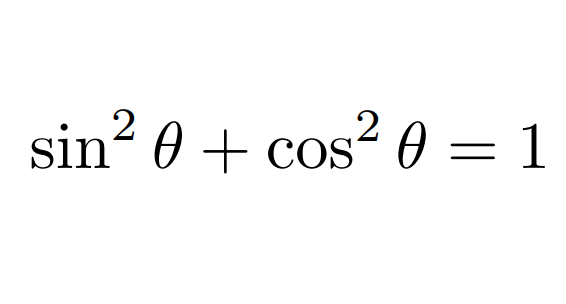
(2)\(\sin^2\theta+\cos^2\theta=1\)
(3)\(1+\tan^2\theta=\dfrac{1}{\cos^2\theta}\)
ただし(1), (3)では\(\theta \neq \dfrac{\pi}{2}+2n\pi\)(ただし\(n\)は整数)とする。
証明
(1)
三角関数の定義より, \(\tan\theta=\dfrac{\sin\theta}{\cos\theta}\)である。
(2)
原点から\(x\)軸となす角が\(\theta\)の方向に伸びる半直線と単位円\(x^2+y^2=1\)の交点が\((\cos\theta, \sin\theta)\)なので, \((\cos\theta, \sin\theta)\)は単位円上の点である。
したがって\(\sin^2\theta+\cos^2\theta=1\)が成り立つ。
(3)
(2)より\(\cos^2\theta+\sin^2\theta=1\)である。
\(\theta \neq \dfrac{\pi}{2}+2n\pi\)(\(n\)は整数)なら\(\cos\theta \neq 0\)なので, 両辺を\(\cos^2\theta\)で割って\(1+\left(\dfrac{\sin\theta}{\cos\theta}\right)^2=\dfrac{1}{\cos^2\theta}\)を得る。
\(\dfrac{\sin\theta}{\cos\theta}=\tan\theta\)なので, \(1+\tan^2\theta=\dfrac{1}{\cos^2\theta}\)となる。
これらの相互関係は基本的で, 三角関数が現れる問題でも非常によく用いる関係です。
これらの関係はつまり, 一つの三角関数の値から別の三角関数の値を求めることができる, ということを言っています。
三角関数の相互関係を用いた例題
三角関数の値を求める問題
\(\sin\theta=\dfrac{2}{3}\)のとき, \(\cos\theta\)の値を求めよ。
\(\sin^2\theta+\cos^2\theta=1\)より, \(\cos^2\theta=1-\left(\dfrac{2}{3}\right)^2=\dfrac{5}{9}\)
よって, \(\cos\theta=\pm\dfrac{\sqrt{5}}{3}\)
\(\theta\)の値の範囲を制限すると, 三角関数の値が符号も含めてただ一つに定まる場合もあります。
\(\tan\theta=-2\), \(\dfrac{\pi}{2}<\theta<\pi\)のとき, \(\cos\theta\)と\(\sin\theta\)の値を求めよ。
\(1+\tan^2\theta=\dfrac{1}{\cos^2\theta}\)より, \(\dfrac{1}{\cos^2\theta}=1+(-2)^2=5\)
\(\cos^2\theta=\dfrac{1}{5}\)となるが, \(\dfrac{\pi}{2}<\theta<\pi\)より\(\cos\theta < 0\)なので, \(\cos\theta=-\dfrac{1}{\sqrt{5}}\)
\(\tan\theta=\dfrac{\sin\theta}{\cos\theta}\)より\(\sin\theta=\tan\theta\cos\theta\)なので, \(\sin\theta=-2\cdot\left(-\dfrac{1}{\sqrt{5}}\right)=\dfrac{2}{\sqrt{5}}\)
証明問題
三角関数の相互関係を用いることで、等式の証明が可能な場合もあります。
次の等式を証明せよ。
$$(\sin\theta+\cos\theta)^2+(\sin\theta-\cos\theta)^2=2$$
\(\sin^2\theta+\cos^2\theta=1\)であることに注意する。
$$
\begin{aligned}
&(\sin\theta+\cos\theta)^2+(\sin\theta-\cos\theta)^2 \\
&=\sin^2\theta+2\sin\theta\cos\theta+\cos^2\theta+\sin^2\theta-2\sin\theta\cos\theta+\cos^2\theta \\
&=2(\sin^2\theta+\cos^2\theta) \\
&=2
\end{aligned}
$$
次の等式を証明せよ。
$$\dfrac{1}{1-\sin\theta}+\dfrac{1}{1+\sin\theta}=\dfrac{2}{\cos^2\theta}$$
\(1-\sin^2\theta=\cos^2\theta\)であることに注意する。
$$
\begin{aligned}
&\dfrac{1}{1-\sin\theta}+\dfrac{1}{1+\sin\theta} \\
&=\dfrac{(1+\sin\theta)+(1-\sin\theta)}{(1-\sin\theta)(1+\sin\theta)} \\
&=\dfrac{2}{1-\sin^2\theta} \\
&=\dfrac{2}{\cos^2\theta}
\end{aligned}
$$
次の等式を証明せよ。
$$\tan\theta+\dfrac{1}{\tan\theta}=\dfrac{1}{\sin\theta\cos\theta}$$
\(1+\tan^2\theta=\dfrac{1}{\cos^2\theta}\)であることと, \(\tan\theta=\dfrac{\sin\theta}{\cos\theta}\)より\(\dfrac{1}{\tan\theta}=\dfrac{\cos\theta}{\sin\theta}\)であることに注意する。
$$
\begin{aligned}
&\tan\theta+\dfrac{1}{\tan\theta} \\
&=\dfrac{\tan^2\theta+1}{\tan\theta} \\
&=\dfrac{1}{\cos^2\theta}\dfrac{1}{\tan\theta} \\
&=\dfrac{1}{\cos^2\theta}\dfrac{\cos\theta}{\sin\theta} \\
&=\dfrac{1}{\sin\theta\cos\theta}
\end{aligned}
$$
コメント